
Page content
When
Hands are an important means of transport for viruses and bacteria. Most viruses and bacteria are transmitted via the hands. It is important to prevent pathogens from spreading and causing infections. Good hand hygiene helps with this. The World Health Organization (WHO) has identified five moments when healthcare workers should disinfect their hands and wash them in special situations. It is good to know that hand disinfection is less stressful for the skin than washing.
Practice hand hygiene at the following five moments:
- before contact with the patient
- before a clean or aseptic procedure
- after contact with body fluids
- after contact with the patient
- after touching the patient's immediate surroundings
More information: Hand hygiene & personal hygiene for employees | SRI guidelines.
How
Follow the instructions below for hand hygiene.
Points to note when disinfecting your hands:
- Ensure your hands are dry and visibly clean before using disinfectant.
- Disinfect all parts of your hands, including your wrists. Use enough disinfectant and keep rubbing until your hands are dry.
- If your hands are visibly dirty, wash them with soap and water according to the WHO instructions below.
Points to note when washing your hands:
- Wet your hands with clean, running water.
- Apply enough soap to cover all surfaces of your hands.
Rub your hands in six steps:
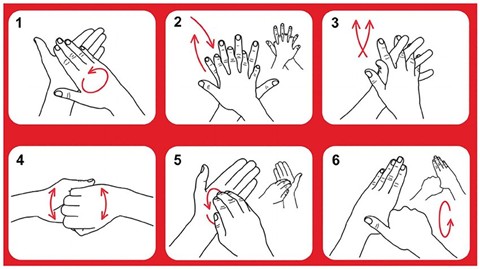
- Rub your palms together.
- Rub the right palm over the outside of the left hand and vice versa.
- Rub your palms together with your fingers spread apart.
- Rub the backs of your fingers toward the opposite palms with your fingers interlaced.
- Rub the fingers of your left hand into your right palm with a twisting motion and vice versa.
- Rub your left thumb into your right palm with a twisting motion, and vice versa.
- When disinfecting your hands, continue rubbing until your hands are dry.
- When washing your hands, rinse them with clean, running water.
- Dry your hands thoroughly with a clean paper towel.
- Use the towel to turn off the tap.
Skin care
- Apply hand cream to your hands when it does not interfere with further care, for example before your (lunch) break or after work, and also on days when you are not working.
- Do not use too much cream at once. A small amount is sufficient.
- It is better to apply a thin layer of cream several times a day than one or two thick layers.
- Choose a hand sanitizer with moisturizing ingredients.
- Only use hand cream from your own tube or from a dispenser.
- If the skin does not recover properly despite applying cream, contact the company doctor.
Skin damage
- If the skin is damaged (e.g., small cuts and wounds), cover it with a waterproof plaster.
- In case of non-intact skin (which cannot be covered with a plaster) and/or eczema: contact the company doctor and, if necessary, the infection prevention expert, about (temporary) adjustments to the work.
See also: Hand hygiene & personal hygiene for employees | SRI guidelines.